

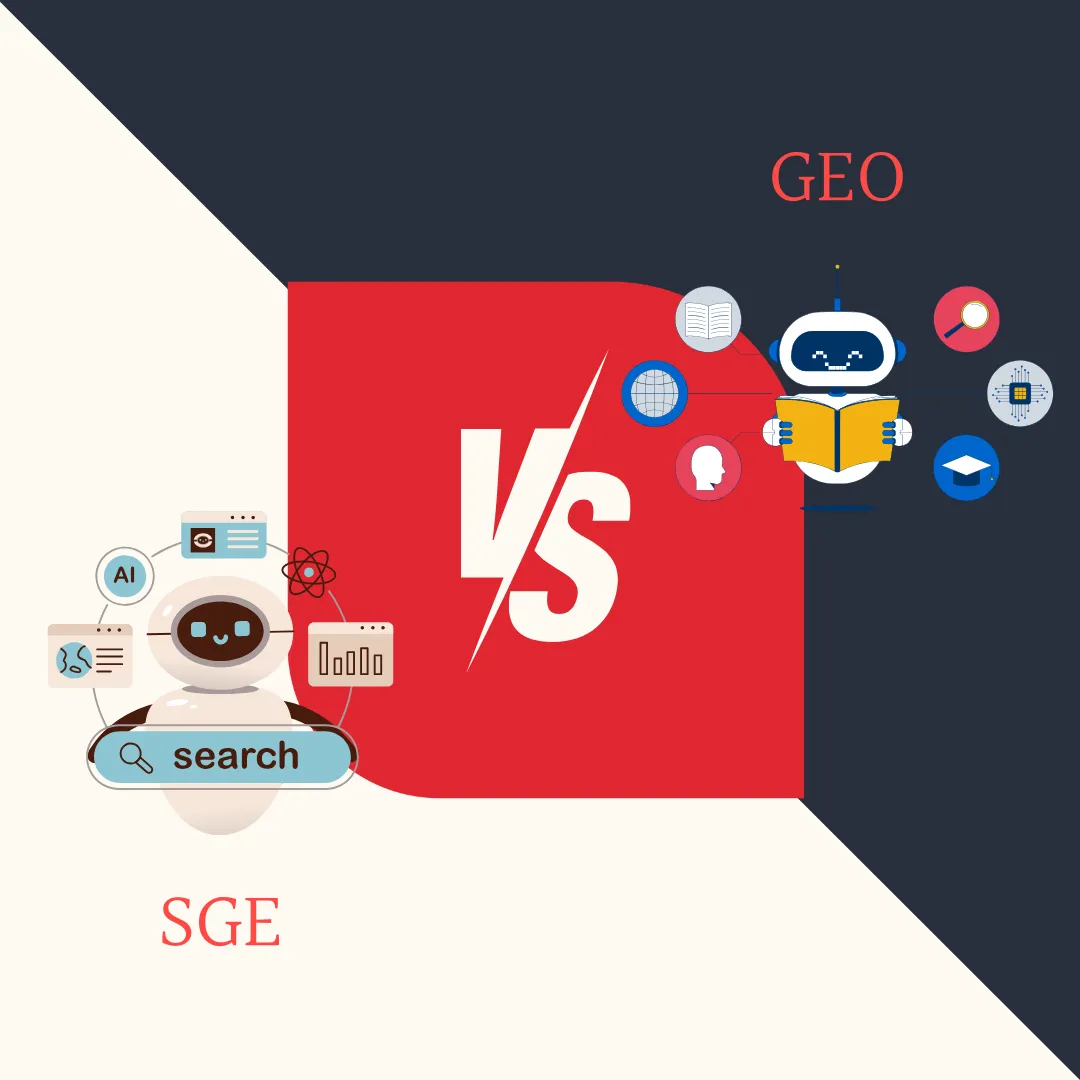
The world of search is at a turning point. In addition to traditional search engines, AI-driven search experiences such as Google SGE and new strategies such as GEO are now emerging.
What do these developments mean for business owners and marketers? In this article, you’ll discover the difference between SGE and GEO, why both are important, and how you can start preparing your content today for the future of search engines.
What is the difference between Google SGE and GEO?
The world of search is changing rapidly. Two terms are popping up more and more often: Google SGE (Search Generative Experience) and GEO (Generative Engine Optimization). They sound similar, but they mean something completely different. In this article, we’ll explain the difference and why both are important for marketers and business owners.
What is Google SGE?
SGE stands for Search Generative Experience. It’s Google’s experiment to display AI-generated answers directly in search results. Instead of just links, users get an AI summary, often supplemented with sources and suggestions.
👉 Read our in-depth blog post here: What is Google SGE?
What is GEO?
GEO stands for Generative Engine Optimization. While SEO focuses on discoverability in traditional search engines, GEO focuses on visibility within AI-driven search engines and chatbots such as ChatGPT, Gemini, or Perplexity.
👉 Read our blog here: What is GEO?
The Key Differences
- Who is the player?
- SGE = Google is experimenting with AI in search results.
- GEO = Marketers’ strategy to optimize content for AI engines.
- Goal
- SGE = providing users with faster, more contextual answers.
- GEO = ensure that your brand or content appears in those answers.
- Impact
- SGE = can divert traffic away from traditional organic search results.
- GEO = a new discipline that determines whether you appear in AI-generated answers.
Why is this important?
- For businesses: Those who rely solely on SEO will soon lose visibility in AI results.
- For marketers: a new playing field is emerging where authority, citations, and content formats will be the deciding factors.
- For users: search experiences will become faster, but also more AI-driven.
How do you combine SEO, SGE, and GEO?
- Continue to focus on SEO: traditional search engines remain important.
- Experiment with GEO: optimize your content so that AI mentions your brand.
- Keep a close eye on SGE: changes at Google have a direct impact on your traffic.
Conclusion
SGE and GEO are not synonyms, but they complement each other:
– SGE is Google’s AI search experience.
– GEO is how you optimize your content for that.
Companies that focus on both GEO and SEO today are better prepared for the future of search engines.
At Are Agency, we help you be visible not only on Google but also in AI-driven search experiences.
FAQ About Google SGE and GEO
1. What is Google SGE?
Google SGE stands for Search Generative Experience. It is an experiment by Google in which AI-generated answers appear directly in the search results, supplemented with sources and suggestions.
2. What is GEO?
GEO stands for Generative Engine Optimization. It is the strategy of optimizing content so that brands and websites become visible in AI search engines and generative answers.
3. How does SGE differ from GEO?
SGE is a Google product (AI in search results). GEO is a marketing strategy to ensure that your brand or content appears in those AI responses.
4. Why is this important for businesses?
Because traditional SEO alone is no longer enough. If you’re not visible in AI results, you’re missing out on opportunities for leads and visibility.
5. Does SGE affect SEO?
Yes. SGE can divert traffic away from traditional organic results. That’s why it’s important to write content that’s both SEO-proof and GEO-proof.
6. How can I get started with GEO today?
Publish authoritative content, secure citations and mentions in reliable sources, and optimize your blogs and white papers so that AI engines can pick them up more quickly.
👉 Want to know how your business can adapt to SGE and GEO? At Are Agency, we help you prepare your content and strategy for the future of search engines.