Everyone says you should do something with AI. Almost no one explains what that should be or why it would be worthwhile for you. We identify where it can actually benefit you, build it, and adapt alongside the technology to meet your specific needs.
Contact us
From Shadow AI to an AIPlanAI
What Your Team Is Using Today0 risks
AI Opportunities on a Matrix8 applications rated
Major ProjectsQuick winsDon't do thisMinor issue
feasibility →impact →
Agreements and Foundations
Q1 Roadmap
0AI tools without agreements
0Applications with a business case
0hours per week to be saved
AI Strategy, in plain language.
What Is an AI Strategy
An AI strategy is
the plan that determines where AI will be deployed in your company, why, and in what order. It answers three questions: Which tasks currently take the most time or money? Which of those can AI reliably take over or speed up? And what do you need to do that safely? The result isn’t a report full of trends, but a concrete list of applications, a sequence of implementation, and agreed-upon guidelines.
There’s a big difference compared to ad-hoc experiments. Without a plan, everyone tries something different, company data ends up in public tools, and no one knows what the results are. With a plan, you consciously choose the applications that offer the greatest return on investment, and you build on what works, step by step.
Where does AI add value in your company?
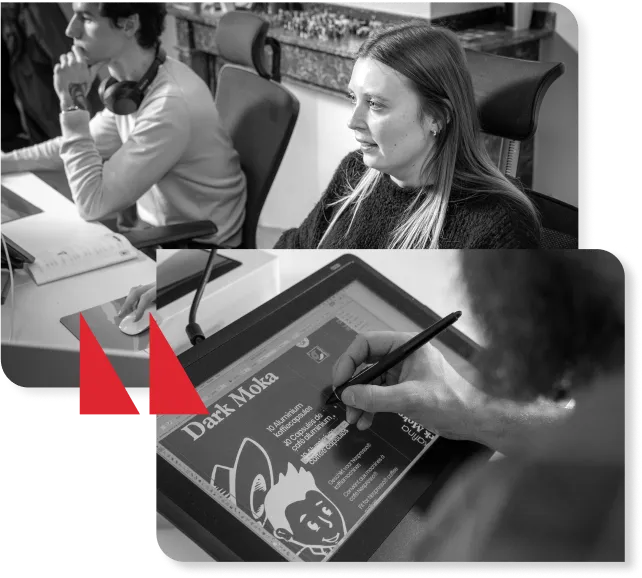
We start with your work, not with the technology. Together with your team, we identify where time is being wasted: preparing quotes, answering emails, processing documents, looking up information, and following up on leads. For each task, we assess what AI can do, how much time or revenue it can save, and how feasible it is with your current systems and data.
Next, we map out each application on a matrix of impact and feasibility. This lets you see right away which quick wins you can achieve within a few weeks, which projects require more preparation, and which ideas are best left on the shelf. If we advise against something, we’ll say so—because not everything that’s possible is worth the effort.
Safe and Responsible: Guidelines for Your Team
Your employees are likely already using AI today, often without anyone knowing what data ends up in which tool. A good AI strategy therefore also sets the ground rules: which tools are allowed, what data should never be stored in a public tool, who is authorized to use what information, and how to handle AI’s suggestions.
Regulations also require this. In addition to the GDPR and NIS2, the European AI Act requires, among other things, that employees working with AI have sufficient knowledge to do so responsibly. We’ll draft a practical AI policy and provide customized training to ensure your team knows what’s allowed, what isn’t, and why.
From Plan to Result
A strategy only pays off when it’s implemented. That’s why every project concludes with a quarterly roadmap: which application to implement first, what it’s expected to deliver, and how much it will cost. You can implement it yourself, or we can build the applications for you—from AI applications and AI automations to AI workers that complete tasks independently.
We deliberately start with a quick win that delivers results within a few weeks. This builds confidence—both in you and your team—and provides the metrics needed to justify the next step. Each quarter, we compare the results against the plan and make adjustments, because AI is evolving rapidly, and your strategy should evolve along with it.

What Can AI Do for You?
Mapping AI Opportunities
We examined, by department and process, where AI can save time, generate revenue, or provide insights, with a realistic estimate of the benefits.
Priorities on a Matrix
Each application was scored on impact and feasibility, so you know what to tackle first and what to set aside.
AI Policy and Training
Clear guidelines on tools, data, and accountability, plus training to make your team AI-literate
Quarterly roadmap
The right applications in the right order, with a goal, a cost, and a quarterly review for each step.
A number of satisfied customers



Do you have any questions about the impact of AI on your organization?
Where do I start with AI in my business?
Start by taking a look at the manual and repetitive tasks you’re doing today. That’s almost always where the first gains can be found. During a no-obligation consultation, we’ll work with you to identify those areas.
Can I get a one-time consultation?
We deliberately choose to provide an ongoing process rather than one-time advice.
AI is evolving faster than any other field in which we work, which means that advice from six months ago can quickly become obsolete.
If you’d prefer one-time advice, we recommend a baseline assessment based on which you can develop a concrete roadmap in the short term.
Is my company too small for AI applications?
Rarely.
Smaller companies often benefit even more from automating and streamlining processes because the impact is felt much more quickly.
Every hour that isn’t spent on people has a huge impact on your organization.
Click here to contact us.
Do you use existing AI tools, or do you build everything yourselves?
We do both.
The right choice depends on the specific situation.
If a good solution exists, it shouldn’t have to be custom-made.
You can always count on us to provide the appropriate and correct advice.
(Even if we don’t make any money on it)
Schedule a no-obligation consultation
Start by understanding where your organization stands