

As an entrepreneur or C-level executive, you want to have control over the entire customer journey: from initial contact to purchase and loyalty. In an era where customers have increasingly high expectations, artificial intelligence (AI) make all the difference.
AI is changing the way customers search, make decisions, and buy. Companies that integrate it strategically create a better customer experience, drive higher conversion rates, and achieve more efficient marketing.
What Is the Customer Journey?
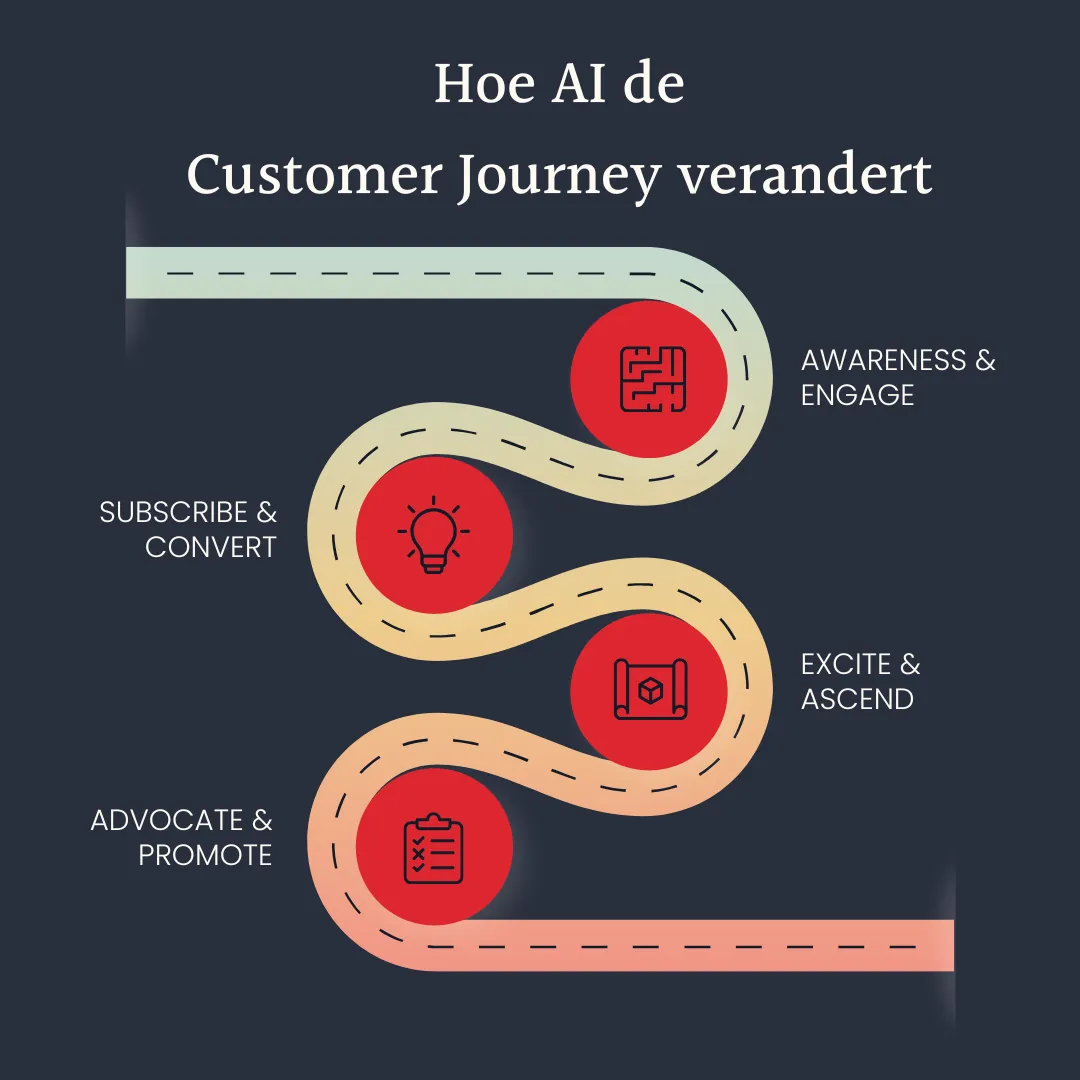
The Customer Journey describes all the steps a customer goes through—from initial contact to becoming a loyal advocate.
- Awareness – Getting to Know Your Brand
- Engage – first interaction with your content or brand
- Subscribe – providing contact information (e.g., email)
- Convert – first purchase or inquiry
- Excite – a positive first experience
- Ascend – upsell, cross-sell, or repeat purchase
- Advocate – customers share positive experiences
- Promote – Loyal customers actively recommend your brand
AI influences each of these phases in a unique way.
How AI Is Changing the Customer Journey
- Awareness: Be Found Faster – With Search Generative Experience (SGE) and AI search engines, customers get answers right away.
- Content that is question-driven and reliable is more likely to appear in AI summaries.
- For SMEs: the opportunity to increase local visibility.
- Engage: Strengthen the first interaction – AI personalizes the content or ads a user sees.
- Chatbots and recommendation systems enable immediate interaction.
- Subscribe: Smart Lead Management – AI analyzes which leads are most likely to become customers.
- Automated lead nurturing increases the likelihood of conversion.
- Convert: Conversion Optimization – Conversational AI (chatbots, voice assistants) helps address customer concerns.
- AI-driven pricing and promotions ensure that customers see the right offer at the right time.
- Excite: Creating a Positive Experience – AI predicts which experience or product will deliver added value.
- Personalized onboarding increases customer satisfaction.
- Ascend: Driving More Purchases – Predictive analytics identifies which customers are ready for upsells or cross-sells.
- AI personalizes offers based on purchasing behavior.
- Advocate: From Customer to Ambassador – AI analyzes reviews and feedback to amplify positive signals.
- Tools identify customers who are willing to share their experiences.
- Promote: Encourage recommendations – AI supports referral programs and rewards loyal customers.
- This is how your brand grows through digital word-of-mouth.
Why AI Isn’t a Replacement for Marketing, but a Booster
AI can analyze data and automate processes, but strategy, creativity, and human connection remain indispensable. Companies that strike a balance between AI efficiency and human expertise earn their customers’ trust and stay ahead of the competition.
How to Get Started with AI in the Customer Journey?
- Analyze your current customer journey – Where are you losing customers?
- Choose one stage to test AI —for example, a chatbot in the consideration stage or a recommendation module in the retention stage.
- Measure the impact – Look at conversions, retention, and customer satisfaction.
- Scale up gradually – Expand to multiple touchpoints.
FAQ on AI and the Customer Journey
- Can AI really improve every stage of the customer journey?
Yes, but the impact varies by industry and company. Start small and scale up. - Isn’t AI too expensive for SMEs?
Not necessarily. There are affordable tools that deliver immediate results, especially in email marketing, advertising, and chat. - How is this different from traditional marketing automation?
AI learns and adapts. Traditional automation follows fixed rules. - Do I need technical knowledge?
No, many AI tools are no-code or plug-and-play. The main challenge lies in developing the right strategy. - How do I integrate AI with my marketing team or agency?
AI takes over repetitive tasks. Your team (or agency) handles strategy, creative campaigns, and quality control.
FAQ on AI and the Customer Journey
1. What exactly is the Customer Journey?
The Customer Journey is the entire path a customer takes: from discovering your brand to making repeat purchases and recommending it to others.
2. How can AI improve the customer journey?
AI streamlines every stage: from improved visibility in search engines to personalized recommendations and automated follow-ups via email or chat.
3. What role does AI play in the awareness phase?
AI helps you get found faster in generative search engines like Google SGE and ChatGPT. This gives local businesses a better chance of appearing in AI-generated responses.
4. How does AI help with purchasing decisions?
With conversational AI (chatbots, voice assistants), customers get immediate answers to their questions. This lowers barriers and speeds up the purchase process.
5. What is the difference between AI and traditional marketing automation?
Marketing automation follows set rules. AI learns and adapts dynamically based on data and behavior, making the experience much more personalized.
6. Is AI in marketing feasible for SMEs?
Yes. There are affordable AI tools that deliver immediate results, such as personalized email campaigns, smart ads, and chatbots.
7. How can I start using AI in my customer journey today?
Start small: choose one phase, such as consideration or retention. Test a simple AI tool and measure its impact. Then you can expand step by step.
👉 Want to know how AI can enhance your customer journey?